


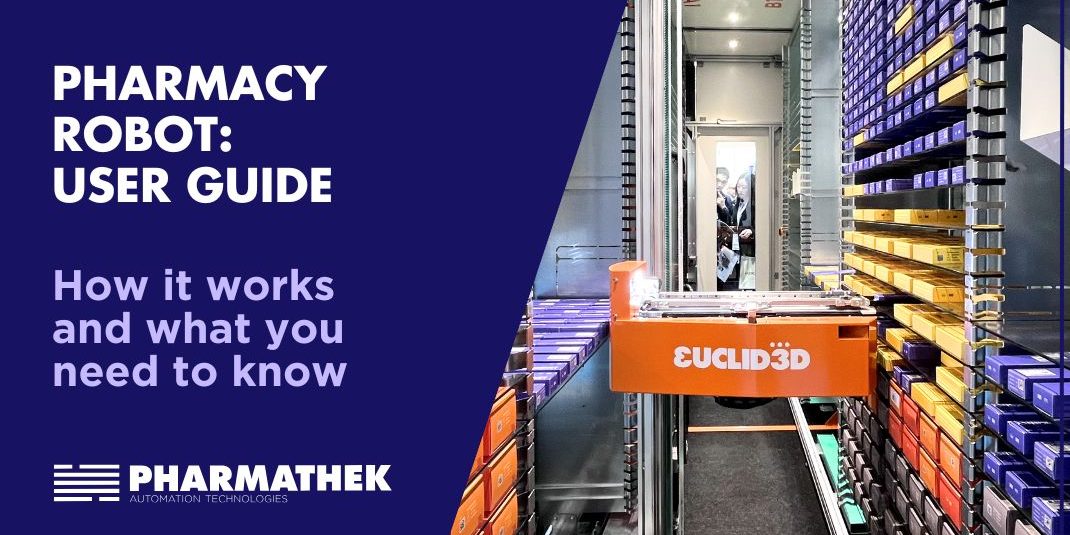
How does a pharmacy robot work? Everything you need to know
In recent years, automation has radically transformed daily operations in pharmacies. More and more pharmacy owners are choosing to install a pharmacy robot as the core of the dispensary or back-office, with the goal of speeding up service, improving stock organization, and reducing dispensing and inventory errors.
A pharmacy robot is a mechatronic system (combining mechanical and electronic engineering) designed to automatically manage the storage, picking, and delivery of medicines. Its purpose is to optimize workflows, free pharmacists from repetitive manual tasks, and significantly improve accuracy in stock handling and dispensing processes.
How does a pharmacy robot work in practice?
The operating principle is simple yet extremely effective: when an order is sent from the counter through the pharmacy management software, the robot identifies the correct package, retrieves it, and delivers it to the output point, usually close to the counter. On average, this process takes just a few seconds, even when multiple orders are handled simultaneously.
Immediate benefits of a pharmacy robot
[ back to index ]
- Operational speed: medicines delivered in just a few seconds.
- Error reduction: precise and reliable product selection.
- Constant order: a well-organized, easy-to-manage stockroom.
- Expiry date control: automatic monitoring and reduced waste.
- Space optimization: smarter use of back-of-counter space.

Architecture designed for efficiency and reliability
[ back to index ]
Internal robot design is one of the key factors influencing performance. The most modern and reliable pharmacy robots use fixed lateral shelves instead of moving cabinets, carousels, or trays. This design choice reduces the number of moving parts, minimizing wear and vibrations, and allows simultaneous access to different areas of the robot, ensuring greater flexibility when handling packages of varying shapes and sizes.
Another important aspect is the absence of fixed channels in favor of virtual channels. Shelves are not divided into predefined compartments but automatically adapt to the size of each box. In this way, the shelf adapts to the product, not the other way around, enabling a more flexible and dynamic stock management system.
Total stock control and traceability
[ back to index ]
One of the main strengths of a pharmacy robot is traceability, although implementation can vary between manufacturers. Each package is registered during loading with its batch number and expiry date, allowing the system to:
- Identify products approaching expiration.
- Monitor real-time stock levels.
- Optimize stock rotation and reduce waste.
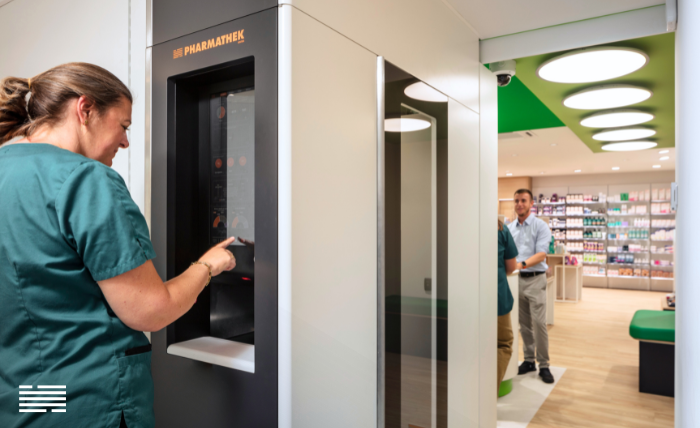
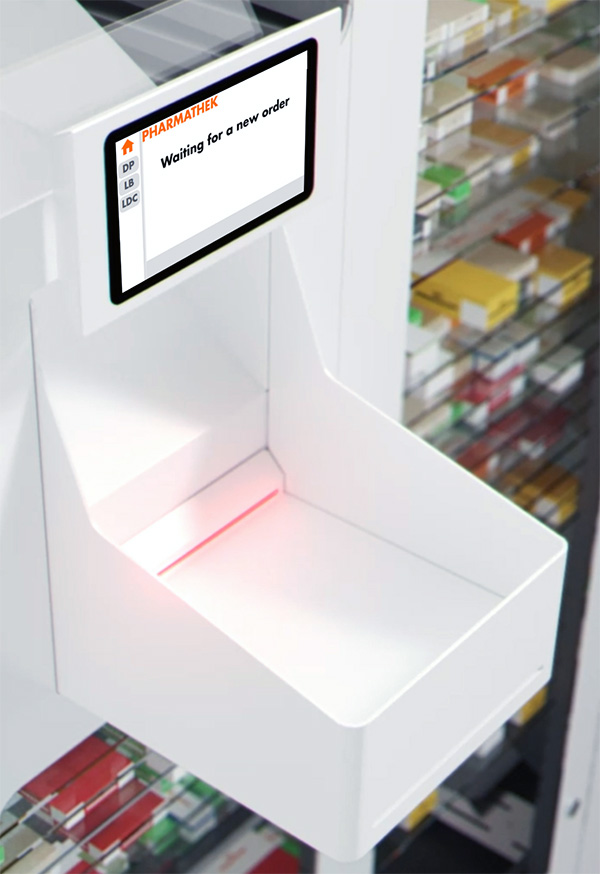
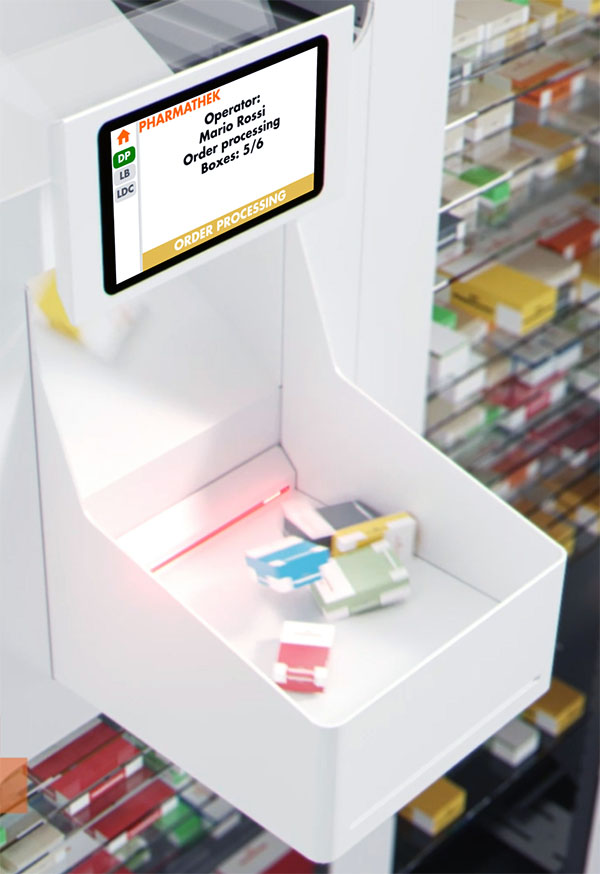
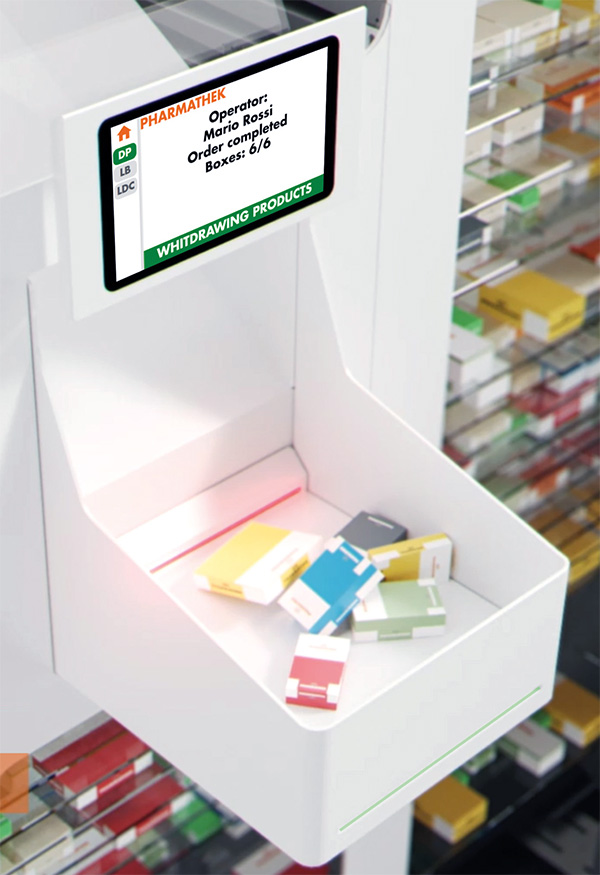
In the most advanced pharmacy robots, traceability extends all the way to the delivery point, and ultimately to the patient. Thanks to patented outputs such as Connected Exit, the system confirms to both the pharmacist and the management software that all products have reached the correct destination, are compliant, and provides the unique code required for decommissioning.
This functionality ensures full compliance with the European Falsified Medicines Directive (FMD), which requires precise tracking of which specific package has been dispensed to each patient.
Fast loading without workflow interruptions
[ back to index ]
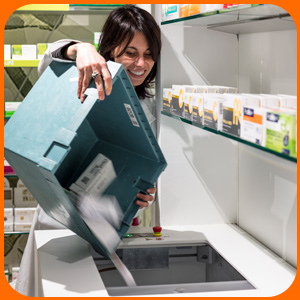
A pharmacy robot can be restocked while it is fully operational. The operator places products in a dedicated loading area, where the system scans the barcode and automatically stores each item in the most suitable position. This allows large volumes to be loaded in just a few minutes without interrupting dispensing activities.
Most robots feature a semi-automatic loading system that requires operator involvement. However, to fully benefit from automation and further reduce manual work, an automatic loader is strongly recommended.
Here, technical choices make a real difference: systems that avoid air suction cups in favor of mechanical push-and-rotation handling perform better. Only push-based handling systems can reliably manage heavier or non-standard packages.

Integration with pharmacy management software
[ back to index ]
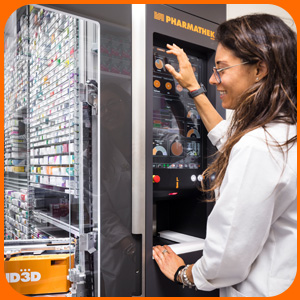
Pharmacy robots are designed to integrate seamlessly with the pharmacy’s management software. Stock levels are updated in real time, all movements are automatically recorded, and pharmacists have a complete, up-to-date overview of inventory status at any moment.
Why automation is a strategic choice for pharmacies
[ back to index ]
Installing a pharmacy robot is not just a technological upgrade: it represents a true organizational shift. Automation optimizes time, reduces errors, and frees up valuable resources so pharmacists can focus more on patient care and professional consultation.
As highlighted in analyses published by iFarma.net, automated storage systems can significantly improve overall pharmacy efficiency, enabling staff to dedicate more time to patient interaction and clinical services.
When choosing a pharmacy robot, it is essential to carefully evaluate two key aspects:
- Engineering and construction quality: these directly affect daily usability and long-term performance. For example, an automatic loader without suction-based gripping systems allows a wider range of packages to be handled reliably.
- Technical support: choose a supplier with strong local coverage and fast 24/7 phone or remote assistance, provided by real operators who can actively support and train the pharmacy team when needed.

Tangible benefits of pharmacy automation
[ back to index ]
- Higher efficiency during peak hours.
- Reduced risk of human error.
- Always organized and fully traceable inventory.
- Significant time savings for pharmacy staff.
- Faster, smoother service for customers.
Frequently Asked Questions (FAQ)
[ back to index ]
Picking is fully automatic. The system receives the order from the pharmacy software, locates the package inside the robot, retrieves it using a rotating robotic gripper, and delivers it to the output point. The process is fast, accurate, and minimizes human intervention.
Yes. A pharmacy robot is designed to manage a wide variety of packaging formats, from blisters to larger bottles. Thanks to intelligent shelf layouts, it adapts to different box sizes without slowing down retrieval operations.
Retrieval typically takes just a few seconds. Timing depends on the number of items requested, their position inside the robot, and how many simultaneous orders are being processed.
Only the most advanced robots organize products based on space optimization and access speed. STRATEGA, the proprietary Learning Machine (AI) system, considers package size, batch, expiry date, and the pharmacy’s historical sales data to place each product in the most efficient location.
Yes. Restocking can take place without interrupting service, using either a semi-automatic loading area or a fully automatic loader that scans barcodes and stores products autonomously.
Yes. The pharmacy robot continuously monitors stock levels and expiry dates, displaying information through its interface or dedicated reports. It also updates the pharmacy management system in real time, helping reduce waste and prevent stockouts.
Space requirements depend on the model and configuration. Modern systems are modular and can be designed to integrate into the back-of-counter area without disrupting existing layouts. They can also be installed on upper or lower floors, provided structural load limits are verified.
Conclusion
[ back to index ]
Today, the pharmacy robot is one of the most effective solutions for improving back-of-counter efficiency and stock management. Speed, accuracy, and full integration with pharmacy software make automation a strategic ally in reducing waiting times, minimizing errors, and optimizing space.
In a context where pharmacists play an increasingly central role in patient care, automation represents a key step toward a more modern, responsive, and efficient pharmacy service.