


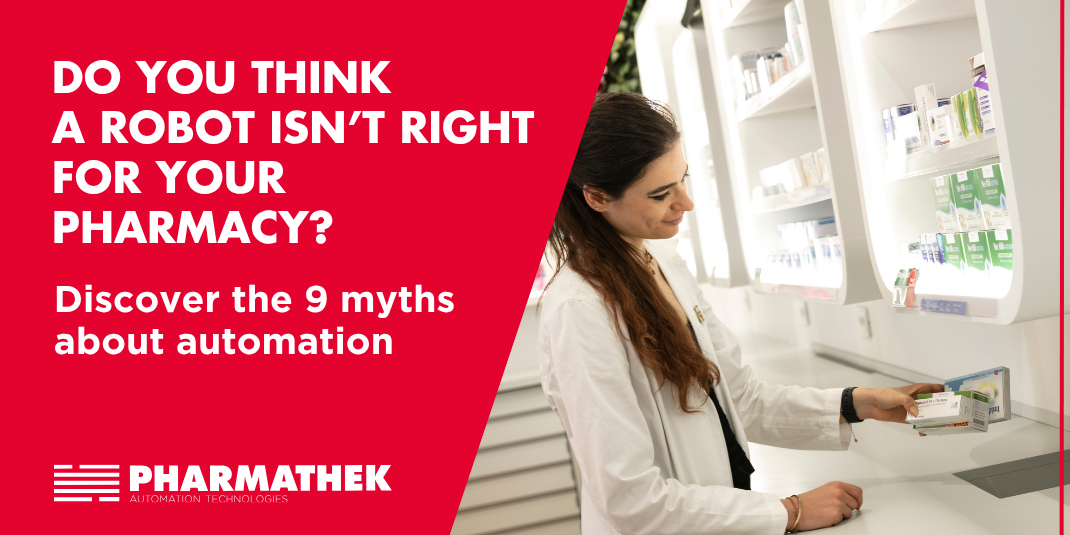
Automation in pharmacies: 9 myths to dispel
“A robot? It wouldn’t make sense in my pharmacy.”
Perhaps you’ve thought this because of the space you have available. Or perhaps because you imagine the installation would be too intrusive, the system too complicated to use, or the investment too difficult to adapt over time. These are understandable concerns. But how much do they actually reflect reality?
When it comes to pharmacy automation, certain preconceptions end up becoming real barriers, even before a concrete solution has been assessed.
That’s why we’ve compiled 9 myths about pharmacy automation and put them to the test using the experiences of real pharmacies that have chosen to automate.
The aim isn’t to convince you that a robot is the solution for everyone. It’s to help you understand whether, and how, an automation project might make sense for your pharmacy.
- Myth 1 | The robot is too big
- Myth 2 | Installing a robot means completely redesigning the pharmacy
- Myth 3 | I’ll lose control of my stock
- Myth 4 | I don’t need a robot
- Myth 5 | It replaces people’s work
- Myth 6 | I’ll be tied to the robot’s configuration
- Myth 7 | The robot must be installed on the same floor
- Myth 8 | I have to close the pharmacy during installation
- Myth 9 | I’ll be on my own if something goes wrong after installation
- Conclusion
Myth 1
“The robot is too big for my pharmacy”
When you think of a robot for a pharmacy, it’s easy to picture a bulky machine that requires a dedicated space and simply won’t fit into a small pharmacy.
The point isn’t to find a pharmacy big enough for the robot. It’s to design the robot to suit the pharmacy.
The robot’s dimensions can be tailored to the available space and, in some cases, the system can be installed exactly where the medicine cabinets used to be. With one key difference: you can handle far more packs in the same space.
SINTESI, for example, is available in various configurations and can also make use of vertical space. This means that automation can be accommodated even in pharmacies with limited space.
This is demonstrated by Scagliola Pharmacy, a pharmacy with less than 40 m² of retail space, where the robot was designed to adapt to the available space and support the pharmacy’s day-to-day operations.
So, before thinking ‘it won’t fit in my pharmacy’, it’s worth asking yourself: ‘How can I make better use of the space I have?’
Because a small pharmacy does not necessarily mean there is little space for automation. It means that space needs to be well planned.
And what if the problem isn’t how much space the robot takes up, but how much needs to be changed to fit it in?
Myth 2
“Installing a robot means completely redesigning the pharmacy”
When thinking about an automation project, it is easy to imagine a completely different pharmacy: new fittings, new layout, major building work and a transformed sales area.
But automation does not necessarily mean starting from scratch.
A well-planned project builds on the existing spaces and seeks the best way to integrate them, concentrating the work wherever possible in areas less visible to customers.
At Santa Chiara Pharmacy, for example, the most significant change took place in the basement storeroom: the robot made it possible to centralise part of the stock there, freeing up a great deal of space.
In the sales area, on the other hand, automation extends to the counters without making any obvious changes to the pharmacy’s layout.
Automation does not always require a complete overhaul of the pharmacy. Sometimes the biggest change takes place precisely where the customer cannot see it.
And when a robot is introduced into stock management, another concern may arise.
Myth 3
“With the robot, I’ll lose control of the warehouse”
In a pharmacy, habits are formed over the years. You know where to look for a particular pack, which drawers you use most often and, in many cases, you know the product codes almost by heart.
This can give rise to a fear: “If the robot manages the boxes, how will I know where they are?”
The reality is that with the robot, you don’t need to know the location of individual packs. And, at the same time, your control over the stockroom actually increases.
You have precise information on expiry dates, stock rotation and packs that haven’t been moved for some time, enabling you to organise returns before they expire.
Marušić Pharmacy, for example, chose SINTESI and Pharmaload precisely to make the receipt, storage and retrieval of products faster and more controlled, with precise monitoring of expiry dates and stock rotation.
You no longer need to know where individual boxes are. You have something more: you always know what’s in your warehouse and what’s going on.
Myth 4
“I don’t need a robot in my pharmacy”
If you think of a robot as a machine that picks up boxes and brings them to the counter, it’s easy to come to this conclusion: “Why would I need one?”
In reality, delivery is just the final step.
The robot can take charge of the stock as soon as it arrives at the pharmacy: it checks incoming orders, stores the packs and, when needed, automatically retrieves the correct product with the nearest expiry date.
The value, therefore, does not simply lie in the fact that a machine retrieves a product for you. It lies in the work it is able to take on throughout the entire process, freeing the pharmacist from a series of operational and repetitive tasks.
And this can also have an impact on the way the customer experiences the service.
At Union Pharmacy, for example, the robot is connected not only to the counter stations but also to the service booths: the pharmacist can have products delivered directly to them during a consultation, without interrupting it.
The result is not just a more efficient stockroom. It is also a more seamless and higher-quality service for the customer.
Myth 5
“Robots replace people’s jobs”
If a machine can handle part of the work, does that mean fewer people will be needed?
It is an understandable concern, but it stems from a misunderstanding: robots do not replace people. They take over certain tasks that people do not necessarily need to carry out.
Handling stock, arranging products, locating packs, checking expiry dates: these are necessary tasks, but they are repetitive and of low value. Entrusting them to technology frees up time for activities where the pharmacist’s expertise makes all the difference: giving advice, listening, building relationships with patients and providing services.
The experience of Chopera Pharmacy illustrates this well. The owner chose to entrust as many management tasks as possible to the robot precisely to give his team more time to devote to patients. Following installation, those who previously carried out the now-automated tasks were able to focus on other important activities for the pharmacy.
Automation, therefore, does not eliminate people’s work.
It changes the way it is distributed.
Myth 6
“If I choose a robot today, I’ll be stuck with this setup tomorrow”
Pharmacies change over time: volumes may increase, premises may change, the organisation of work may evolve, or new requirements may arise.
This can give rise to a fear: “If I design the automation in a certain way today, I’ll have to stick with it tomorrow.”
An automation project should not be a snapshot of the pharmacy at the moment it is installed. It can evolve alongside the pharmacy, through expansions and new integrations.
This is what happened at the San Miniato Basso Municipal Pharmacy: after installing SINTESI in 2020, a few years later the pharmacy expanded the project by connecting a new dispensing station, integrated into the existing configuration.
Automation, therefore, does not necessarily have to be an end in itself. It can be a project capable of growing alongside the pharmacy.
Myth 7
“The robot must be on the same floor as the sales area”
When you think of a robot in a pharmacy, it’s natural to picture it nearby and, if possible, in plain sight. “If I can’t see it, how am I supposed to know what’s going on?”
In reality, the robot can also be installed in a different space or on a different floor from the sales area, connected to the workstations through the most suitable system.
You don’t even need to be right next to the robot to know what’s going on: with GEMINI, the Pharmathek robot’s dashboard is accessible from any authorised device in the pharmacy.
The Internazionale pharmacy in Bologna, for example, has installed SINTESI in the basement, freeing up space for the sales area and the service area.
The Blesa Pharmacy in Tenerife, on the other hand, chose to install it on the upper floor. The Connected Exits allow the team to see in real time what is being dispensed, which order it belongs to and what is on its way.
It is not the floor that determines whether automation can work. It is the design that finds the best way to connect the pharmacy’s spaces.
Myth 8
“To install a robot, I have to close the pharmacy”
A pharmacy cannot simply decide to close for a few days. There are customers to serve, staff to organise and permits to apply for.
It is understandable to think that installing a robot means bringing business to a complete standstill and complicating everyone’s work.
In reality, the installation can be planned in such a way as to minimise the impact on day-to-day operations.
Work in areas accessible to customers can be concentrated during closing times, such as lunch breaks or at weekends.
And, when replacing an existing system, temporary solutions can be put in place to keep the pharmacy running.
The Bellato ai Ferri Pharmacy, for example, never closed whilst the robot was being replaced: a temporary dispensing unit allowed them to continue dispensing medicines whilst the new system was being installed.
Because even a complex project must adapt to the pharmacy, not bring it to a standstill.
Visualizza questo post su Instagram
Myth 9
“Once it’s installed, if anything goes wrong, I’m on my own”
When introducing a major piece of technology into a pharmacy, it’s natural to wonder what will happen if, one day, something goes wrong.
Who will help me if I have a problem? How long will I have to wait? What if the robot stops working?
It’s an understandable concern: choosing a robot also means entrusting it with a significant part of the pharmacy’s day-to-day work.
With Pharmathek, support isn’t just there when there’s a problem. The team monitors every system over time, with two scheduled visits a year and constant data analysis to identify potential issues and take action before they occur.
And when you need them, there are real people on the other end of the phone. The team can intervene promptly remotely or, if necessary, be at the pharmacy within a few hours.
The Bucine Pharmacy knows this only too well: after 13 years of using a SINTESI robot, it has once again chosen Pharmathek for its new robot. Among the factors that influenced this decision was the constant presence of a support team that has been well-known and tried and tested over the years.
Because you don’t choose a robot just for the technology it offers. You also choose it for the people who will continue to look after it over time.
9 myths, one question
We’ve discussed space, installation, use, the pharmacist’s role, stockroom organisation, the evolution of the solution and support.
But all these myths have something in common.
They stem from the idea that there is only one way to automate a pharmacy.
Whether it’s a large or small pharmacy.
A robot in a specific space.
A certain way of working.
A configuration that remains unchanged over time.
The reality is different.
Every pharmacy has its own space, workflows, volumes, staff and requirements.
For this reason, even before asking which robot to choose, it is worth understanding which problem you want to solve and how automation could fit into the way your pharmacy operates.